
Ladies and gentlemen!
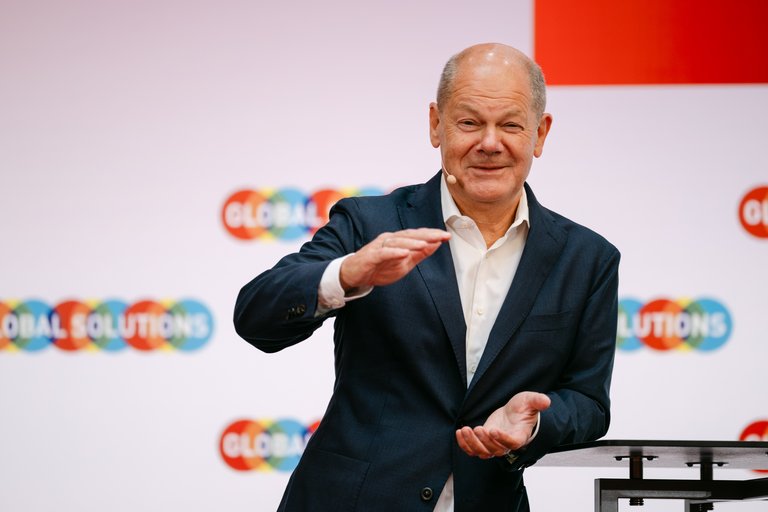
It’s great to be back here at the Global Solutions Summit. The reason I’m happy to be here lies in the name of your conference. I think it’s a good one! It’s not called the “Global Problems Summit”, the “Global Challenges Summit” or the “Global Crises Summit.” It’s called the Global Solutions Summit – and that’s exactly the emphasis I like.
Because the world is what it is. We do have problems, challenges, and crises – yes, indeed. And they are not getting any fewer. We must identify, understand, and analyze them all very clearly. But then it becomes even more urgent to search for solutions. Pragmatic solutions. Realistic solutions. Workable solutions. Solutions that fit the situation as we find it. And compromises, of course, because interests always differ.
There is a German saying that translates as “You can only dance with who is in the room”. In English, one might say: “You have to play the hand you’re dealt.” And that is why the theme of your summit this year is so well chosen: “Finding Common Ground in a Fractured World.” This sums up the fact that this may simply not be the right time for entirely new “grand designs”. But that is precisely why we must find – with even greater urgency – the points on which we can build understanding.
Not every solution has to be a brand-new invention. Sometimes the solutions we have already found are the most important ones. I would like to promote two solutions here that are not new – but fundamental.
One key point on which we need global understanding is a clear commitment to the international legal order established since 1945. That is a goal the world urgently needs to embrace, protect, and defend today. Because developments in recent years make it clear that the willingness to disregard international law remains undiminished.
Obviously, the most glaring example of this is Russia’s war of aggression against all of Ukraine, which President Putin launched unprovoked in February 2022. At the time, I described this as a “Zeitenwende”, a turning point. I did so above all because Putin’s war of aggression represents a fundamental break with the basic principles of the rules-based international order.
This order includes the unconditional agreement that borders must not be changed by force. It also involves overcoming the disastrous concept of “spheres of influence”. That is the idea that great powers may pressure and conquer smaller states at will – simply because they can. Or because they consider themselves historically justified in doing so.
But no state is merely the “backyard” of another, stronger state. Every single state, regardless of its size, has a right to territorial integrity. Every state has the right to decide sovereignly its own path and its alliances. There should not be a “Russki Mir” – a “Russian World” – just as there should not be a “Sinosphere” or a “Western Hemisphere” dominated by the United States.
And let me add here: It is difficult to see how recent actions taken by the United States regarding Greenland, Venezuela, or Iran could possibly be compatible with international law.
The second time-tested legal solution I would like to mention was written into law almost 350 years ago. This, too, can contribute to orderly cooperation among all states worldwide, regardless of their political systems – democratic or otherwise.
I am referring to the principle of habeas corpus, which dictates that no person may be unlawfully detained or imprisoned without judicial review. We should strive to ensure that all states respect the principle of habeas corpus in relation to their citizens. Because opponents of the government do not belong in prison anywhere.
So: No change of borders by force and habeas corpus – these are two solutions that are urgently needed. They do not solve all the world’s problems, but they are the conditions for even attempting to pursue many other important solutions. It should be our ambition to achieve both goals in this century. And I firmly believe that this is possible.
But how do we get there?
Not all countries in the world are democracies, and some will not become democratic anytime soon. Realism demands that we say this. But in a globalized world we must still work together.
As a deeply committed democrat, however, I would also like to add: Strengthening democracy around the world remains necessary. It is also possible. It will only be successful, however, if democracy and the rules-based international order are not perceived as “Western values,” but rather as universal principles shared by like-minded partners in the emerging multipolar world.
Promoting this message can only work, if it never comes across in the Global South as patronizing or condescending. In Europe – including Germany – we often still fail to fully grasp how strongly people in the Global South react to lectures from the “Old West.” As Germans and as Europeans, we would do well to ease this atmosphere with humility and with great caution.
We should abandon the still widespread notion of Europe as the ultimate benchmark of historical development – because we are not. This is a necessary process of mental adjustment that the Indian historian Dipesh Chakrabarty has called “provincializing Europe.”
In an evolving multipolar world with 10 billion inhabitants, Europe will simply no longer be the linchpin. We will be one significant global province among other significant global provinces. No more, no less! Not viewing this as a historical decline, as a loss and humiliation – that is one of the great challenges we face today. And I would add: It is the entire Global North that faces this challenge – which of course includes Russia.
We will not meet this challenge through nostalgic navel-gazing, but with a great deal of pragmatism. With realism and a willingness to embrace the changes in the world. That is essentially the third solution I am proposing today. We will then discover that, as self-assured equals, we can and we will continue to make our contributions to the world. I believe this is a positive outlook that inspires hope.