
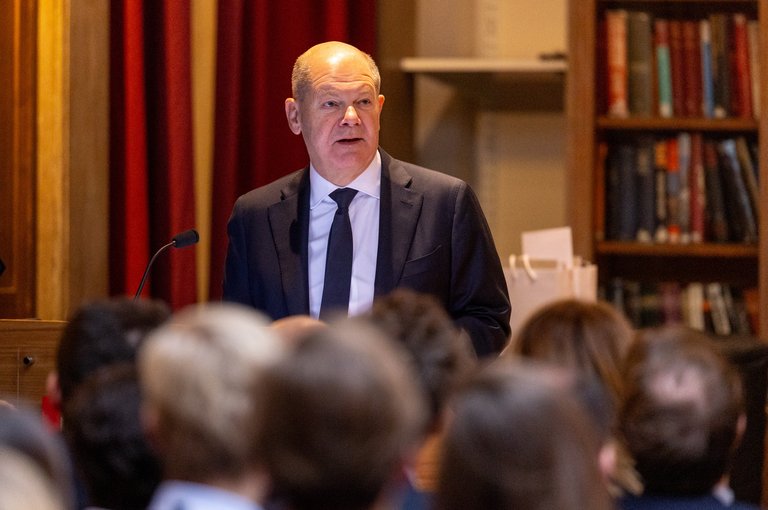
Ladies and gentlemen,
“Thoughts on the Causes of the Present Discontents” – this was the title of an influential work by the Irish politician and philosopher Edmund Burke. His pamphlet, written in 1770, is considered important because it was an early elaboration on the role of political parties within parliamentarianism and constitutional government. Incidentally, this pamphlet also contains a sentence that has always been true, but which seems particularly relevant today – and I quote: “When bad men combine, the good must associate; else they will fall one by one (...).”
We would do well to take this sentence seriously and heed it! This applies to us in Europe – and let’s never forget: the United Kingdom, is a European country, too – even if it is not a member of the European Union. This also applies in the broader international and global context. And it certainly applies regarding our joint response to the “Zeitenwende”, the historic turning point brought about by Russia’s president Putin. The gruesome, cruel and illegal war of aggression that Russia is waging against Ukraine has been going on for almost exactly four years now. I will, of course, go into more detail on this topic – or any other topic – during the subsequent question-and-answer session, if asked.
However, on this occasion today, being here at the London School of Economics, I would first like to address another issue of particular relevance for our times – another “Zeitenwende” that we absolutely must address in our societies. Edmund Burke's writing came back to me because its title – “Thoughts on the causes of our present discontents” – is literally found in another book. I am referring to Michael Young's groundbreaking work “The Rise of the Meritocracy”.
This, for me, is a truly foundational text. It moved, influenced and shaped my political thinking deeply. And I am particularly delighted to have the opportunity to talk about it here with you today. For Michael Young was not only the primary author of the famous Labour Party Election Manifesto of 1945 – “Let Us Face the Future!” He was not only a chief architect of the British welfare state. He was not only a great social activist, innovator and social entrepreneur. He was also, above all else, a perceptive and clear-sighted sociologist – right here at the LSE, which was his alma mater. It was here in the early 1950s that he developed his classic work, “Family and Kinship in East London” – according to experts one of the most influential and pathbreaking sociological studies of the 20th century.
But what really made Michael Young world-famous, was his book “The Rise of the Meritocracy”, published in 1958. “The Rise of the Meritocracy” is a unique combination of dystopian satire, sociological study, social diagnosis and prophetic prediction of future developments. Written seven decades ago, this book is nonetheless full of insights that are as prescient today as ever – arguably even more so today than before. That is a truly remarkable achievement!
Michael Young was the inventor and originator of the term meritocracy. Mind you, for him, “meritocracy” was not something desirable. That was precisely the point he was making. But much to Young’s dismay he had to watch as – over the years – he lost his authority over the term. What he had invented as a pejorative term was reinterpreted as a positive concept.
Social democrats – of my generation in particular – are accustomed to understanding “meritocracy” as something that is desirable. “We are meritocrats”, said Tony Blair in his adoption speech as candidate for Sedgefield in 2001. What he meant by this was the shared belief in a society in which it is no longer inherited privilege, traditions or possessions that determine one's position in society, but rather ability, skill and competence. Or, in a word: merit.
And there's no question about it: if I have a toothache, I need a good dentist; if I'm going on a flight, I definitely want a competent captain and well-trained air traffic controllers; if my computer, my car or my heating is broken, I want the best specialists possible. What could be wrong with that?
Well, there's nothing wrong with it at all! And certainly, from a social democratic perspective the sentence “We are meritocrats” was about even more – namely equal opportunities for all, good life chances for all, as far as possible. “Aufstieg durch Bildung” – “advancement through education” – that was and still is a deeply held conviction of many social democrats, liberals and other progressives. Or to quote another famous – and incredibly successful – Tony Blair slogan: “Education, education, education!” This proved to be an extremely convincing and successful campaign motto. And so again: What could be wrong with that?
Opening educational opportunities to broad sections of the population, which (not least) social democrats made possible in the second half of the 20th century, was a great historic achievement. I, for one, would not have had access to academic education without this tremendous expansion of life opportunities. And the same is true for many millions of people throughout the western industrialised world, certainly here in the United Kingdom and in Germany. All of them – all of us owe our opportunities, our advancement and even our prosperity to the educational revolution of recent decades. The rise of the meritocracy, along the lines predicted and described by Michael Young, has indeed taken place. It is a historical fact.
But with this rise of meritocracy have come the negative effects that Young warned about – and that is precisely what makes his 1958 book so truly prophetic and so relevant today. Young accurately predicted that in a society based on the principle of merit, the “meritocrats” would look down smugly on everyone else. A new social class of permanent “meritocrats” would emerge and become entrenched – one that considers itself superior because it is better educated, more distinguished and wealthier. They then believe that the fate of the “others”, the less educated and less productive, is – as it were – their own fault. Thus, the meritocratic spirit of a society makes even considerable inequality seem justified.
Given these conditions, the supposedly “less capable”, the left-behind and disadvantaged, would become demoralised, frustrated and resentful, disengaged, disaffected – and eventually angry and hateful. Based on this analysis Young 70 years ago predicted the populist backlash, which we are experiencing today in so many of our democratic western societies – as a direct consequence of the meritocratic spirit and structure of these societies. He even introduced the term “populists” itself to describe the perpetrators of what in his book – following Burke – is called the “present discontents”.
According to Young‘s assessment, the ultimate populist uprising would take place in the year 2033. We all know that the rise of the populist movements of our time in fact started earlier – but that in no way alters the acuteness of Young‘s analysis and prophecy. It is therefore quite understandable – and justified – that his criticism of meritocracy is currently enjoying a kind of second spring.
Young’s thoughts have recently been echoed in many academic publications. I will mention just a few here, for example Michael Sandel’s “The Tyranny of Merit” or “The Meritocracy Trap” by Daniel Markovits. Likewise, in his book “The Great Global Transformation” Branko Milanovic describes “America's new ruling class: Homoploutia with credentials”. By this Milanovic means an elite both wealthy and educated, which holds all the high-level positions and significant assets. Another writer, Oren Cass, takes a very conservative stance in his book “The Once and Future Worker” – a title that I, as a social democrat, view with some jealousy. And finally, in her books “Strangers in their Own Land” and “Stolen Pride” the liberal sociologist Arlie Russell Hochschild also focusses on the connection between loss, shame, and the rise of the political right. All these writers, in one way or another, build on Young's work.
So, what can we learn from all this? And, more importantly, what should we do about it? There is a lot that could be said here. But I have to be brief and will therefore limit myself to a few basic remarks. Shortly before his death in 2002, Michael Young spoke out once again to complain. The Prime Minister, he wrote, “has caught on to the word (meritocracy) without realising the dangers of what he is advocating”. “It would help,” he added, “if (he) would drop the word from his public vocabulary, or at least admit to the downside.”
I still remember it well: Those remarks, published in the Guardian, really made me think again. And it was a consequence of this reflection that many years later, I chose “respect” as the central theme of my election campaign of 2021. Because it is true: Our democratic societies cannot thrive if they are run by meritocratic elites that look down smugly on all those who are less educated and less successful. They cannot thrive if, conversely, those who are less successful are consumed by their (justified) anger at “those at the top”. Success based on effort and merit remains okay. Equality of opportunity remains important, “education, education, education” remains important. But what is just as important is – respect!
Respect, good working conditions and good wages for every single individual who contributes in his or her own way to our societies – whether as a teacher or as a cleaner, as a doctor or as a kitchen assistant in the fast-food shop around the corner. They all make their contribution – they all belong. They all have a right to dignity and pride. We need to develop clear ideas about community, the common good and social cohesion that encompass our societies in their entirety. Otherwise, our liberal democracies will blow up in our faces. That, I believe, is Michael Young's enduring message for our time. And that is why I am so grateful to have been given the opportunity to speak about this important issue – here today at the LSE, at Michael Young’s alma mater.
Thank you very much – and now I look forward to your questions.