Ladies and gentlemen!
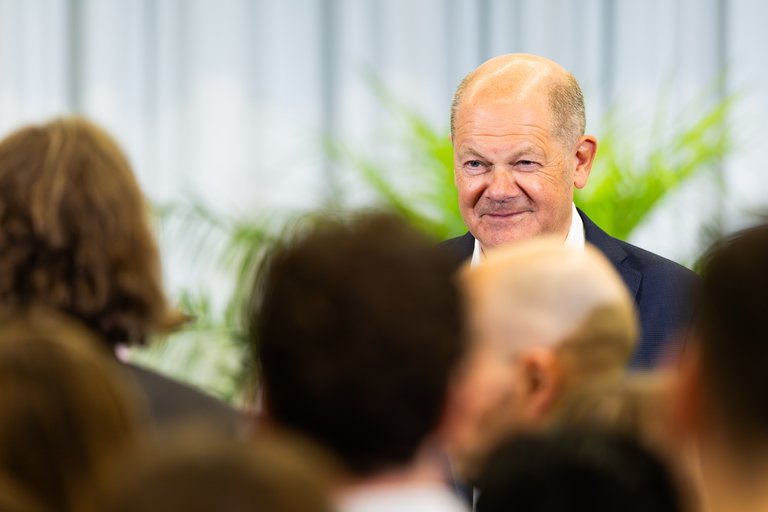
I am delighted to be here with you today in Vallendar.
As Federal Chancellor I held a town hall event just a few kilometres downriver from here, in Bendorf.
I also remember my speech at the “Deutsches Eck” in Koblenz a few years ago.
I even spent a short holiday in Maria Laach – a beautiful location very close to here – to go hiking around the lake there.
But I have never before been in Vallendar, and here at the renowned Beisheim School.
In that respect, today is a first, which I am particularly pleased about.
What I also like is the setting for this visit. I always think it's a good thing when students organise conferences on their own initiative, as you are doing here.
I recently gave a speech in London at the LSE at a similar event, and I am always very happy about these opportunities because student audiences are often particularly open, curious and critical.
So with this in mind, thank you very much for your invitation! It is a pleasure to be here with you!
I am even happier to be here because I find the topic of your conference very relevant.
It is about finding the right balance between the economy, entrepreneurial initiative and sustainability.
In my opinion, this combination of factors is crucial indeed when it comes to tackling the major challenges of the coming decades.
However, I suggest to add three more categories – or factors –, without which I firmly believe we will not be able to achieve a good and sustainable future.
These factors are social cohesion, respect and speed – or acceleration.
On these the three categories I would like to make a few general comments.
I will be brief, though, so there will be enough time for more specific issues.
And you are of course welcome to ask me any other question you may have.
First, I believe it is particularly important that we focus on the relationship between social cohesion and sustainable development.
That is the task we face today. Because we will not get the one without the other.
A country that is not internally cohesive will not be able to achieve sustainable development.
And the reverse is also true: A country that fails to achieve sustainable development in the 21st century will find it increasingly difficult to maintain long-term internal cohesion.
When it comes to this interaction between sustainable development and cohesion – or the lack of cohesion –, I am not only thinking of the United States – although that is an obvious example.
I am also thinking of Germany and other countries here in Europe.
To put it quite bluntly: We must resolutely continue the path we have chosen towards sustainability, climate neutrality and industrial transformation – especially if we want to secure economic success and social cohesion in the long term.
That is my firm belief!
At the same time a note of caution is in order here – and this is important.
We must take into account that all our options for government action are limited due to the freedom of choice enjoyed by companies.
They can simply decide to relocate their investments and jobs elsewhere.
Of course, there are answers to this.
The “Global Minimum Tax” is one such answer.
The Climate Club, which I promoted during my term in office, is another answer.
We need to develop solutions like these.
But we must be aware that these issues remain difficult – and that a great deal of pragmatism is required on our path to sustainability and social cohesion.
Having said that:
What we know for certain is that turning away from sustainability goals and from climate protection altogether – as we are now seeing in the United States –, is definitely the wrong way to go.
What is looming here is a negative spiral in which lack of sustainability and dwindling social cohesion reinforce each other.
I do not wish to dispute the existence of this negative correlation. Of course it exists.
And some political actors on the far right even have a vested interest in perpetuating this vicious circle. I will not downplay this.
The fact that there is political polarisation in in the United States – but also in Germany and other European countries – has been demonstrated by a number of recent elections, including state elections here in Germany.
Where radical nationalist, authoritarian and populist movements are gaining support, all democratic parties and all other relevant actors must ask themselves what they can do better.
It is true that major crises have unsettled many citizens in recent times.
Pandemics, wars, climate change, irregular migration, inflation – all of these have left their mark.
We all have been affected.
Targeted disinformation campaigns from outside, aimed at destabilising and undermining our liberal democracies, are undoubtedly having their effect here too.
There is a tendency for citizens to feel overwhelmed or left behind in the face of diverse changes in the world and here in our country.
And it is also true, unfortunately, that some people lose their confidence from time to time – and some even permanently.
All of this does exist. So the crucial question is: If we want our country to succeed, if we want change, if we want positive results, if we want sustainable development to succeed – what should be at the heart of our communication, our debates and discourse?
It is perfectly clear what does not help.
What does not help is bad mood, negativity, pessimism, gloom and doom!
No one who wants a good and sustainable future for our country can be interested in collective bad mood, in polarization and in the constant invocation of disaster scenarios.
None of this helps.
But at the same time it is my firm belief that in Germany we really are not so far apart on many key issues.
The vast majority of citizens are in favour of climate and nature conservation – and at the same time they do not want to be overburdened.
A large majority welcome foreign workers – and at the same time they support state control of irregular migration.
The vast majority are in favour of supporting Ukraine in its defence against attack – and at the same time they demand diplomacy.
The vast majority of citizens simply get on with things instead of complaining.
That is the case everywhere – at work, in social clubs and initiatives, on a voluntary basis and from deep within, intrinsically motivated.
But the cohesion I am talking about here, and the confidence I am talking about here, only work under one condition that is particularly important to me.
And that condition is: Respect!
Respect, decent working conditions and good wages for every single individual who contributes in his or her own way to our societies – whether as a teacher or as a cleaner, as a doctor or as a kitchen assistant in the fast-food shop around the corner.
They all make their contribution – they all belong.
They all have a right to dignity and pride.
We need to develop clear ideas about community, about the common good and social cohesion that encompass our societies in their entirety.
Otherwise, our liberal democracies could blow up in our faces.
There is yet another reason why our democracies could fail.
This applies to our economic basis, but it also applies from the point of view of citizens' satisfaction – or dissatisfaction – with their political and administrative system.
This could happen if we are not fast enough, if we are not efficient enough.
Let me describe it in very stark terms.
Since 2008, China has succeeded in creating a 50,000-kilometre high-speed rail network – from scratch.
Every year, 3,000 kilometres of additional railway lines are being built in China.
By 2030, the total length is expected to reach 60,000 kilometres.
Here in Europe the situation is different.
Let me give you just one example, because I am particularly familiar with it:
The construction of two new local rail lines in the east of Hamburg was decided during my term as Mayor of the city, which ended in 2018.
We are talking about a total of around 60 kilometres of new lines here – completion is expected around 2030 and 2045.
Don't get me wrong: It is a good thing for Hamburg that these connections are being built.
In other areas, too, we have already achieved a great deal – for example, in terms of expanding our power lines and the construction of LNG terminals on the north German coast.
But the pace of progress is still far from sufficient!
This is true not only in Germany and in Europe, but also in the United States.
Everywhere, approval procedures have become increasingly complicated since the 1960s – due to political decisions and legislation, but also due to case law.
To use the words of American-Chinese author Dan Wang: In China – and not only there – what prevails today is an engineering spirit, while in our Western democracies it is the lawyers, who dominate.
I am a lawyer myself. But for me, it is clear:
We must accelerate! We must become faster – faster again, in all areas that are important for building a sustainable future for our Western societies.
If we want to win the future, we need a climate-friendly agenda for growth and efficiency.
If we want to win the future, we must join the debate progressive democrats in the USA are conducting under the banner of “abundance”.
I do not accept the objection that acceleration is incompatible with democratic principles.
In West Germany after the Second World War, we built hundreds of thousands of new flats in cities year after year.
What was possible then, must be possible again today.
The need is there. Public demand is there.
We must make this change happen; we must transform ourselves into a sustainable future.
And to address a frequent objection: No, this acceleration we need is not about “less democracy”; quite to the contrary: It is about giving greater weight to the democratic will of the voters.
So those are my three key points:
We need social cohesion!
We need respect!
And we need to move faster!
I am certain: This will also lead to a brighter, more sustainable future for our democracy and its institutions.
Thank you very much – and I look forward to your questions.